Please ensure Javascript is enabled for purposes of website accessibility
Estate Planning for Military Families

Estate Planning for Military Families

Estate Planning for Military Families

Whatever the time of year, it is always good for members of the military and their loved ones to create or revisit their estate plan. Military families face unique estate planning considerations that others do not, especially when a family member is deployed overseas or receives a temporary duty assignment. In addition, service members have access to special benefits and resources that can add complexity to the planning process, so seeking help if you are a military family is important.

Whether you are beginning your military service or have been serving for some time, the following may be important in your estate planning.

Factors to Consider

Estate plans should be customized to each person’s particular circumstances. As you create or update your plan, consider whether it addresses the following:

  • Do you own real property and, if so, is it located in different states or countries?
  • Are you married?
  • Do you have minor children or children with special needs?
  • Do you have retirement savings, such as a 401(k), an individual retirement account, or a Thrift Savings Plan?
  • Are you planning to make charitable gifts?
  • Do you anticipate multiple moves across states or international borders?

Each of these considerations can significantly impact the structure and effectiveness of your estate plan.

Estate Planning Necessities

Many of the benefits offered to military families can help with estate planning. These include the following:

  • Life insurance. Life insurance is an important part of an estate plan intended to benefit those who are financially dependent upon you when you pass away. Active-duty members often have access to low-cost life insurance for themselves and their loved ones from Servicemembers’ Group Life Insurance. You can find more information on the Department of Veterans Affairs (VA) website. When examining how your life insurance fits into your overall estate plan, work with us to ensure that the beneficiary designation works as expected.
  • Last will and testament. Also known as a will, this crucial document outlines to whom, how, and when you want your assets (money, accounts, and property) distributed following your death. It also allows you to designate who you want to wind up your affairs after you pass away (referred to as an executor or personal representative, depending on the state) and specify who will care for any minor or special needs children.
  • Revocable living trust. A trust is a separate legal entity that can hold property and accounts for the benefit of one or more people or entities. Similar to a will, a trust allows you to dictate who will receive your property at your death and how that property is to be administered. For a trust to work as intended, your assets must be retitled into the name of your trust, and your trust must be designated as the beneficiary of the assets that must remain in your name (e.g., life insurance and retirement accounts). While you are alive and well, you will likely be the initial trustee, which puts you in charge of managing the assets you have transferred to the trust. An added benefit of a trust is that it also provides instructions on who will step in and manage the trust assets during any period of your incapacity (inability to manage your own affairs) and after your death. For most families, a trust-centered estate plan is a better fit because it avoids the probate court process. A will can be adequate for some families depending on their circumstances, even though it does not avoid probate.
  • Other benefits for survivors. Survivor benefit plans (SBPs) are pension-type plans in the form of an annuity that will pay eligible survivors—typically your surviving spouse and dependent children—a monthly benefit at your death. Likewise, Dependency and Indemnity Compensation (DIC) is a tax-free monthly benefit paid to eligible survivors of service members or Veterans who (1) die while on active duty, active duty for training, or inactive duty training; (2) died from a service-related disease or injury; or (3) were receiving, or entitled to receive, VA compensation for a service-related disability rated as totally disabling (100 percent) for a specified period of time before death. When evaluating any financial service or insurance product, it is a good idea to work with an estate planning attorney to ensure that any associated beneficiary designations align with your overall plan and provide the maximum benefit to your family.

You Need Specialized Help

Members of the military often experience frequent moves, have access to several forms of government benefits after service, and can be subject to some unusual tax rules. For these reasons, estate planning for military families is more complicated than it is for most others.

An estate planning professional can assist you in setting up the following:

  • Powers of attorney for financial matters and healthcare decisions (very helpful tools when a spouse is deployed)
  • Living wills and other medical directives
  • Powers of attorney or delegations of parental authority for minor children or separate guardian nominations
  • Funeral and burial arrangements
  • Wills
  • Organ donation authorization
  • Family care plans
  • Life insurance
  • Trusts
  • Survivor benefits

An estate plan has multiple objectives: to provide for your family’s financial security, to ensure your property is preserved and passed on to your loved ones in the way that you desire, to determine who will manage your assets upon your death, and to determine who will be your agent(s) during your lifetime if you become incapacitated.

We can guide you through the best options available to you and your family. Call us today.

Planning for your Child’s Future: A Parent’s Guide to Special Needs Trusts

Planning for your Child’s Future: A Parent’s Guide to Special Needs Trusts

As a parent of a child with special needs, you already spend every day thinking about their future.
This guide walks you through the basics in plain language, so you can walk into your planning
conversation feeling prepared and confident.

What Is a Special Needs Trust?

A special needs trust helps preserve the public benefits your child receives, even if they later receive
an inheritance, a settlement, or other assets. It can also help protect assets set aside for long-term
care — all while keeping essential programs like Medicaid and SSI intact.

Two Types of Special Needs Trusts

Which type of trust best fits your family depends on whose assets are funding the trust.

Two Types of Special Needs Trust

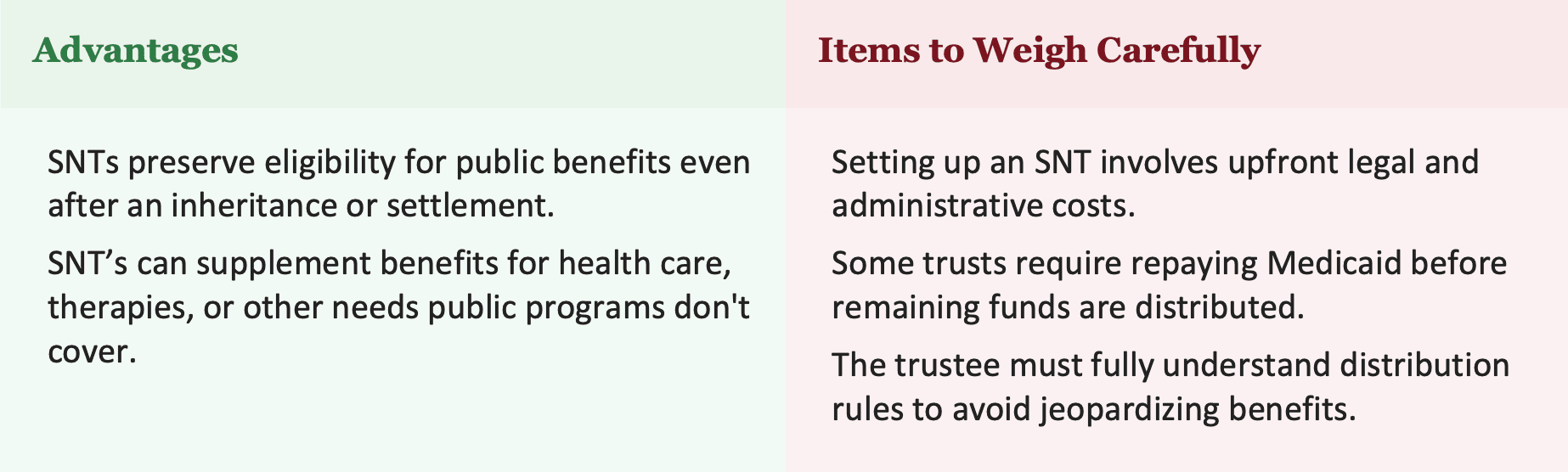
Weighing the Options

Getting Started: Key Considerations

✓ Select a trustee you trust to manage funds responsibly and follow the rules.
✓ Write a letter of intent describing your child’s needs, routines, and preferences.
✓ Let family members know trust exists so gifts or inheritances are directed correctly.
✓ Work with an experienced special needs planning attorney to set it up properly.

How Trust Funds Can Be Used

Funds from a special needs trust are meant to supplement the income your child receives from
government programs.

Every family’s situation is different. We would love to help you build a plan that fits your child’s needs.

How to Choose a Trustee

How to Choose a Trustee

When you establish a trust, you name someone to be the trustee. A trustee does what you do right now with your financial affairs—collect income, pay bills and taxes, save and invest for the future, buy and sell property, provide for your loved ones, keep accurate records, and generally keep things organized and in good order.

Key Takeaways

  • You can be the trustee of your revocable living trust. If you are married, your spouse can be co-trustee.
  • Most irrevocable trusts do not allow you to be a trustee.
  • Even though you may be allowed to be your own trustee, you may not be the best choice.
  • You can also choose an adult child, a trusted friend, or a professional or corporate trustee if your health is declining. 
  • Naming someone else to be co-trustee with you helps your co-trustee become familiar with your trust, allows your co-trustee to learn firsthand how you want the trust to operate, and lets you evaluate your co-trustee’s abilities.

Who Can Be Your Trustee

If you have a revocable living trust, you can be your own trustee. If you are married, your spouse can be a trustee with you. If either of you becomes incapacitated or dies, the other can continue to handle your financial affairs without interruption. Most married couples who own accounts and property together, especially those who have been married for some time, are usually co-trustees.

However, you do not have to be your own trustee. Some people choose an adult son or daughter, a trusted friend, or another relative. Some prefer a professional or corporate trustee (e.g., a bank trust department or trust company) for the experience and investment skills these entities offer. Naming someone else as trustee or co-trustee does not mean you lose control. The trustee you name must follow the instructions in your trust and report to you. You can even replace your trustee if you change your mind.

When to Consider a Professional or Corporate Trustee

A professional or corporate trustee is valuable in several instances. You may be elderly, widowed, or in declining health with no children or other trusted relatives living nearby, or your other candidates may lack the time or ability to manage your trust. On the other hand, you may simply not have the time, desire, or experience to manage investments by yourself. Also, certain irrevocable trusts may not allow you to be trustee due to tax laws and for public benefit laws restrictions. In these situations, a professional or corporate trustee may be exactly what you need: they have the experience, time, and resources to manage your trust and help you meet your investment goals.

What You Need to Know

Professional or corporate trustees will charge a fee to manage your trust. However, the fee is generally quite reasonable, especially when you consider their experience, the services provided, and the investment returns that a professional trustee can deliver.

Actions to Consider

  • Honestly evaluate whether you are the best choice to be your own trustee. Someone else may do a better job than you, especially with regard to investing your money.
  • Name someone to serve as co-trustee now. This eliminates the time a successor would need to become knowledgeable about your trust, your accounts and property, and your beneficiaries’ needs and personalities. It would also allow you to evaluate whether the co-trustee is the right choice to manage the trust in your absence.
  • Evaluate your trustee candidates carefully and realistically.
  • If you are considering a professional or corporate trustee, talk to several. Compare their services, investment returns, and fees.

We can help you select, educate, and advise your successor trustees so they will have support and know what to do next to carry out your wishes. When you are ready, feel free to call us to discuss this information.  

Estate Planning Scams: What Seniors Need to Know

Estate Planning Scams: What Seniors Need to Know

Creating an estate plan is an important step in protecting your loved ones and ensuring that your assets are distributed according to your wishes. Unfortunately, scammers know that people who want to safeguard their estates are often willing to act quickly.

Even a carefully drafted estate plan can be undermined if you fall prey to a fraudulent scheme. Scammers often leverage fear, urgency, and lack of familiarity with the estate planning process. According to a 2023 report from the Federal Bureau of Investigation, victims of financial fraud who were aged 60 or older lost an average of about $34,000 that year to scams.1

Being aware of common tactics and warning signs can help you safeguard your finances and your family.

Why Seniors Are Targeted

Older adults are often the focus of estate planning scams because they:

  • have accumulated significant assets over time;
  • may face more complex estate planning decisions;
  • may be less familiar with the legal requirements and details of trusts, wills, and powers of attorney; and
  • may be less familiar with technology and how it can be used to access personal information.

Scammers capitalize on these factors, exaggerating risks and claiming their service is the only solution. They may insist that avoiding their service will result in large tax consequences, lost inheritance, or financial ruin—even when those threats are irrelevant to your situation.

Common Types of Estate Planning Scams

Estate planning scams take many forms, but the following are some of the most common:

  • Trust mills. Non-attorney companies repeatedly sell low-cost, generic trusts. Such trusts usually offer little real protection and may be used to gather personal information or to upsell financial products.
  • Fake or unlicensed attorneys. Individuals claiming to provide legal services or be associated with a law firm often create overpriced or unnecessary legal documents.
  • Bogus “probate avoidance” or “secret” trusts. Scammers may promise to eliminate probate or create secret trusts that are not legally enforceable.
  • Unnecessary investments or insurance. High-commission annuities, life insurance, or “exclusive” financial tools are frequently sold under the guise of improving your estate plan.
  • Identity theft schemes. Some scams request sensitive personal information under the pretense of preparing your estate documents.

Red Flags to Watch For

Be cautious if a provider does any of the following:

  • Pressures you to act immediately or claims there is no other option
  • Guarantees large tax savings, secret benefits, or unusually high returns without reviewing your situation
  • Solicits services through unsolicited phone calls, emails, door-to-door visits, or direct mailers
  • Cannot verify credentials or is reluctant to provide references or licensing information
  • Exploits fear by exaggerating threats of taxes, probate, or lost inheritance

Scammers often prey on emotions, making victims feel anxious or rushed. Remember that a legitimate estate planning attorney will calmly explain your options, allow time for questions, and customize a plan specific to your needs.

Steps to Protect Yourself

  1. Verify credentials and reputation. Confirm that anyone offering estate planning services is a licensed attorney in your state. Check online reviews, professional directories, and bar association listings.
  2. Ask questions and demand clarity. You should fully understand what each document does, why it is needed, and any associated costs or commissions.
  3. Be cautious with additional products. Insurance, annuities, or other financial tools should complement your estate plan, not be its main purpose.
  4. Avoid unsolicited offers. Be skeptical of anyone contacting you out of the blue about estate planning.
  5. Report suspicious activity. If you suspect a scam, contact local law enforcement officials or the national fraud hotline at 1-800-876-7060.

Protecting Your Estate Plan

The best defense against scams is working with a qualified, licensed estate planning attorney. Our trusted team members can help you create enforceable documents tailored to your needs, ensuring that your assets are protected and your wishes are honored. Being informed and vigilant is the most effective way to keep your estate plan—and your loved ones—safe. Contact our office today.

1 Elder Fraud, in Focus, FBI (Apr. 30, 2024), https://www.fbi.gov/news/stories/elder-fraud-in-focus.

Handling a Loved One’s Debts After They Die

Handling a Loved One’s Debts After They Die

Americans are, quite literally, getting buried in debt, with nearly half expecting to pass away with outstanding debts.1

As a general rule, a person’s debts do not go away when they die. Some types of debt, such as federal student loans, are typically forgiven upon the debtor’s death, but private loans and cosigned accounts may still be owed after the debtor has passed away. State laws also play a factor in the post death debt settlement process.

While nearly half of Americans think they will pass on their debts when they die, you can take proactive steps now to protect your loved ones from inheriting or becoming responsible for your debts. If you are an estate’s executor/personal representative or have been contacted by a debt collector about a deceased family member’s debt, you should understand your rights and obligations.

One Nation, Under Debt

Debt is as old as civilization itself. Lending at interest can be traced back to ancient Mesopotamia and the use of promissory notes to facilitate trade. The United States has carried debt since its inception, borrowing money from domestic investors and the French government to fund the Revolutionary War.2

Total consumer debt eclipsed $17 trillion in 2023, up from $15 trillion in 2021, according to credit reporting agency Experian.3 The largest and most common debts include:

  • Mortgages ($11.5 trillion in 2023)
  • Auto loans ($1.51 trillion)
  • Student loans ($1.47 trillion)
  • Credit cards ($1.07 trillion)
  • Personal loans ($571 billion)4

The total average individual debt balance in 2023 was $104,215, up from $101,915 in 2022 and $96,371 in 2021.5

According to Debt.org, 73 percent of Americans die owing money.6 The average amount of debt they die with is nearly $62,000.7

What Happens to Your Debt when You Die

You are probably familiar with the expression “buried in debt.” It might hit close to home if you are like most Americans struggling to pay off existing loan balances. However, do you know what happens to your debt when you die?

The answer depends on factors that include the type of debt and the state where you live. In most cases and most states, your loved ones are not stuck with your unpaid bills because creditors are paid only from the assets (e.g., a home, car, bank accounts, investment accounts) that are (i) part of your probate estate and go through a probate court or (ii) in your revocable living trust.

If you do not leave behind enough assets in your probate estate and living trust to fully cover the debts owed, creditors may have to settle for what is available. There are some exceptions to the idea that surviving family members and other heirs are not on the hook for the debt, including:

  • A person who cosigns on a loan;
  • The spouse of a deceased person who lives in a state with community property laws (Arizona, California, Idaho, Louisiana, Nevada, New Mexico, Texas, Washington, and Wisconsin); and
  • The spouse of a deceased person who lives in a state that requires a surviving spouse to pay certain healthcare expenses and other kinds of debt. (Note: In Missouri and Kansas, the common law doctrine of necessaries can make a surviving spouse liable for medical expenses, depending upon the circumstances).

The rules governing when a surviving spouse is responsible for paying unpaid medical bills are complex and vary by state. It is important to work with an experienced estate or trust administration attorney to ensure that your affairs are wound up correctly.

Surviving spouses and adult children are frequently contacted by debt collectors attempting to collect on bills for the medical care of their deceased loved one, according to the Consumer Financial Protection Bureau. However, unless the survivor also agrees to the medical debt or is responsible under state law, they are generally not liable for the debt.

Not All Debts Go Away at Death

Debts not inherited by a specific individual under the exceptions described above do not just disappear, except for debts that are dischargeable by death.

For example, federal student loans, including Direct Subsidized Loans, Direct Unsubsidized Loans, Direct Consolidation Loans, Federal Family Education Loans, and Federal Perkins Loans, are usually discharged when the borrower dies, as long as the loan servicer receives proof of death.8

Private student loans are a different story. Some lenders of private (i.e., nonfederal) student loans offer a death discharge, although it is not the norm. They may come after the loan’s cosigner (if there is one) or the estate for repayment of the outstanding balance on the loan.

Secured versus Unsecured Debt

Determining how and when to pay a debt after the debtor has passed away and who or what may owe the debt can depend on whether the debt is secured or unsecured.

  • Secured debt is backed by collateral (a tangible asset the lender can repossess or sell if the borrower does not pay back the debt). Common examples of secured debt are mortgages (secured by the real property) and car loans (secured by the vehicle). Secured debts are typically paid off before unsecured debts when a probate estate is settled during the probate process. If estate assets are insufficient to cover the secured debt, the lender can seize the collateral to recoup their losses.


    In rare cases and under select jurisdictions, legal protections may be available for surviving spouses who wish to remain in a primary residence subject to a creditor’s claim. These protections may delay or prevent foreclosure if the spouse cannot pay off the mortgage in full.

  • Unsecured debt is not backed by collateral (that is, there is no specific asset backing the debt). Unsecured debt includes credit card debt and personal loans.


    Unsecured creditors have lower priority than secured creditors in probate. If the probate estate has enough funds, unsecured debts are paid off before any inheritance is distributed. However, if the estate lacks sufficient funds to satisfy all its debts, unsecured creditors are typically last in line for repayment and may not receive the full amount they are owed.

Funeral expenses also take priority over some creditor claims. Any state and federal taxes that the decedent owes, as well as probate estate administration expenses incurred during probate (e.g., legal and accounting fees), may also supersede creditors.

Knowing which debts have priority over others in probate is the responsibility of the estate’s executor/personal representative. If the individual assigned this role in an estate plan does not follow state probate laws, they could be personally responsible for debts that should have been paid but were not because the executor did not pay creditors in the correct order.

How to Plan for Debt and Leave More Money for Your Loved Ones

“You can’t take it with you” applies to what you owe every bit as much as what you own.

Your outstanding debt could create potential complications for loved ones. Your family may not personally get stuck with your unpaid bills; however, if you do not pay off your debts before you pass away, they may be forced to deal with debt collectors harassing or contacting them. Worse still, there may not be any money or property left to distribute to your loved ones in probate court or through the trust after everything has been liquidated to pay creditors. Here are some protections that your loved ones are afforded:

  • State and federal law limits whom debt collectors are authorized to contact—and how they can contact them—to discuss outstanding debts. Spouses and other survivors should not automatically assume that they have to pay and should delay any conversation regarding payments of outstanding debts until they have discussed the specific circumstances with a lawyer. Collectors who go too far or provide misleading information can face potential consequences.
  • When a beneficiary inherits a home, they also take possession of the home subject to any outstanding mortgage and are ultimately responsible for that debt. Anyone inheriting a home or other significant asset, such as a vehicle, with an outstanding loan balance must know their obligations to the lender. They may have to sell the house to pay off the mortgage or apply to transfer the mortgage to their name. In addition, individuals have the right to refuse a gift from an estate if they do not want or cannot afford it. In some cases, federal law will allow a decedent’s heirs to assume the mortgage on a property without triggering a due-on-sale clause, ensuring that the loan remains in place after the owner’s death.
  • Every state has different laws and procedures surrounding debt repayment. Things can quickly get complicated, so it is best to work with a local estate or trust administration lawyer if there are any concerns about how unresolved debts could affect the surviving family.

Estate planning is about the legacy that you leave behind. If that legacy includes debt, an estate planning attorney can offer advice for getting it under control during your lifetime or help your family deal with the consequences of your debts after death. Call us if you need assistance planning for your debt or winding up a loved one’s affairs.

1 Myles Ma, SPFC, 46% of Americans expect to pass on debt to their loved ones when they die, Policygenius (Jan. 9, 2024), https://www.policygenius.com/life-insurance/2024-financial-planning-survey-passing-on-debt-after-death.

2 FiscalData, https://fiscaldata.treasury.gov/americas-finance-guide/national-debt.

3 Chris Horymski, Experian Study: Average U.S. Consumer Debt and Statistics, Experian (Feb. 14, 2024), https://www.experian.com/blogs/ask-experian/research/consumer-debt-study/#s3.

4 Id.

5 Id.

6 Bill Fay, What Happens When People Die with Debt: Who Pays? (May 16, 2023), https://www.debt.org/family/people-are-dying-in-debt.

7 Id.

8 FederalStudentAid, https://studentaid.gov/manage-loans/forgiveness-cancellation/death.

Why Retirement Is the Right Time to Revisit Your Estate Plan

Why Retirement Is the Right Time to Revisit Your Estate Plan

Retirement can mean many different things to different people. For some, it opens up a new world of travel, experiences, and creative pursuits. For others, it may herald quiet days at home with a good book, a steaming mug of tea or coffee, and no other plans for weeks.

Between those extremes are countless ways to spend one’s post-working years. Like work itself, retirement takes various forms, shaped by practical needs and personal preferences. However, retirement demands one thing above all: adaptability.

While the pace of your days may be slower in retirement, life does not stand still. We are living longer, spending more years in retirement, and dealing with new financial and personal realities. Whether you are approaching retirement or already in it, this stage calls for a fresh look at your estate plan and timely adjustments that match your next chapter.

Retirement Today: Key Trends Shaping Your Estate Planning

Work is not just something we do to make money; rather, we typically see our jobs as a defining part of our identity.

However, no matter how much we may like our jobs, or at least recognize the structure and stability they bring, many of us also find that there is more to life than working. Retirement is supposed to be the reward for a lifetime of hard work, and it still is for many Americans. They turn age 65, start collecting Social Security and enroll in Medicare, and begin to do all the things they never previously had time for.

The retirement picture has changed over the decades. While it theoretically remains the final phase of the American Dream, retirement for most of us looks much different than it did for our parents or grandparents. These differences reflect cultural changes and evolving financial conditions that shape how we live, work, and, ultimately, retire.

Living Longer, Often with Higher Costs

Retirees are living longer, increasing the length of their retirement and their expected healthcare expenses. These factors affect how long savings last and may influence estate planning priorities as well.

  • As of 2025, the projected life expectancy for Americans who have reached age 65 is 83 years for men and 86 years for women.1 In 1940, the projected life expectancy for a 65-year-old was 77 years for men and 79 years for women.2
  • Today, median retirement savings for households aged 55–64 is about $185,000,3 below many recommended benchmarks.
  • About one-third of retirees are very concerned about being able to cover healthcare costs,4 and for good reason. A 65-year-old retiring today could spend more than $170,000 on healthcare alone during retirement.5

Estate Planning Perspective: Due to longer lifespans and rising healthcare expenses, your estate plan may need updates to ensure that your lifestyle and legacy goals are supported well into retirement, including provisions for medical care, long-term support, and financial flexibility.

Retirement Is Not What It Used to Be

Older adults today are often working longer or pursuing encore careers, meaning that retirement does not always start at a set age. Working past traditional retirement age can affect income, assets, and estate-planning timelines.

  • The average retirement age is now around age 62, up from age 57 in the early 1990s.6 In 2023, approximately 19 percent of adults age 65 and older were still working, up from 11 percent in 1987.7
  • Nearly one in four adults age 50 and above who are still working expect to never fully retire,8 and workers age 75 and older are the fastest-growing age group in the workforce, more than quadrupling in size since 1964.9
  • Many retirees pursue part-time work or side ventures,10 adding new assets or income streams to their financial picture.

Estate Planning Perspective: Your estate plan should address your current income, any new assets, and the possibility that retirement may start later or look different than you originally expected.

Fixed Incomes and Savings Pressures

Many retirees rely on fixed income, drawing from Social Security, pensions, or savings. Inflation, market volatility, and healthcare costs can affect how long assets last.

  • Nearly 50 percent of adults age 60 and above have household incomes below what is needed for basic living expenses.11
  • Inflation hits retirees harder than near-retirees because retiree income often does not rise as quickly as prices do.12
  • Approximately 64 percent of Americans are worried that they will outlive their retirement savings.13

Estate Planning Perspective: If you rely on fixed income or are drawing down investments, revisiting your estate plan can help protect both your current lifestyle and the financial legacy you intend to leave for loved ones.

Shifting Family and Lifestyle Dynamics

Downsizing, relocating, or buying new homes later in life is increasingly common, which can significantly affect asset ownership and estate planning priorities.

  • Baby boomers, at 42 percent, represent the largest share of home buyers, a significant increase from previous years.14
  • A growing number of retirees are embracing multigenerational living, often taking the form of sharing a home with children and grandchildren15 or cohousing, where they live in private homes within a community that shares common spaces and support.16
  • More retirees are ditching their homes for recreational vehicles (RVs) and year-round life on the road.17

Estate Planning Perspective: Changes in living arrangements, whether downsizing, moving in with family, or spending extended time on the road, can affect property ownership status, associated taxes, and the effectiveness of your current estate plan. It is important to review how your property is titled, provisions regarding what you would like to happen to your property within any trusts, and beneficiary designations to ensure that all are aligned with your current situation and goals for the future.

Staying Active, Traveling, and Lifestyle Considerations

Living longer and with better overall health means that retirees today are far from slowing down. Between bucket-list travel, volunteering, and new hobbies, retirement is increasingly more about reinvention than rest.

  • Senior travel trends include more “golden gap years”18 or long-term travel among retirees.
  • Older Americans are getting out more in retirement, with senior participation rates in outdoor activities such as hiking, camping, and fishing showing a marked rise in recent years.19
  • A growing number of Americans over 65 are launching small businesses to stay active, pursue passions, and have more control over their work in “retirement.”20

Estate Planning Perspective: A more adventurous, entrepreneurial, and mobile retirement can introduce new risks and responsibilities. Tweaking your estate plan to account for business interests, recreational vehicles, new retirement investments, and contingency plans keeps it aligned with how you live today.

Thinking More Intentionally About Legacy, Gifting, and Long-Term Care

Retirees are increasingly focused on intentional legacy planning, including lifetime gifting and charitable contributions, while balancing higher healthcare costs and the potential need for long-term care as they age.

  • More older Americans are embracing a “giving while living” approach to their heirs and inheritance.21 In fact, older people are also the most likely to make donations to charities.22
  • Long-term care costs are skyrocketing. Average costs range from more than $150,000 per year for in-home health aide and homemaker services to more than $125,000 per year for a private nursing home room.23

Estate Planning Perspective: As your priorities shift toward value-driven giving, charitable contributions, and planning for long-term care costs, your estate plan should evolve to reflect not only financial goals but also personal values and the impact you want to leave on your family and community.

Revisiting Your Estate Plan: Practical Scenarios for Retirees

While retirees and near-retirees have a sense of the cultural and economic forces that are shaping the current retirement landscape, they may be unsure about how these changes should translate to their estate planning decisions. Here are some real-world scenarios that take into account what retirement means today—and what it might mean for your estate plan.

Longevity and Healthcare Costs

Situation: You are retired, living longer than expected, and facing rising medical or long-term care expenses.

Scenarios to evaluate:

  • You find yourself relying more on Social Security or pension income than you had originally anticipated.
  • Market fluctuations are affecting the sustainability of your retirement portfolio.
  • Healthcare, long-term care, or caregiving costs are higher than anticipated.

Possible estate planning updates:

  • Review and update beneficiary designations on your retirement accounts and insurance policies. This is especially important after opening new investment or retirement accounts, rolling over a 401(k) into an individual retirement account (IRA), or purchasing new life insurance or hybrid life and long-term care policies. Even one outdated beneficiary form can derail an otherwise solid estate plan.
  • Evaluate tax-efficient withdrawal and distribution strategies, including how required minimum distributions (RMDs), Roth conversions, Social Security timing, and Medicare premium brackets may affect both your lifetime cash flow and the assets ultimately passing to your beneficiaries.
  • Review long-term care planning options such as incorporating provisions for incapacity, updating powers of attorney, or considering a trust structure designed to help protect assets from future care expenses (based on your state’s laws and eligibility rules).

Health and Lifestyle Adjustments

Situation: A new medical diagnosis, evolving long-term care needs, or living in multiple states is prompting changes in your medical or personal planning.

Scenarios to evaluate:

  • You or your spouse has received a chronic or progressive health diagnosis.
  • You want to remain safely at home with appropriate in-home care or are considering assisted living as part of your long-term care strategy.
  • You split time between residences in different states—each with different rules for healthcare documents, guardianship, and Medicaid eligibility.

Possible estate planning updates:

  • Update healthcare directives and powers of attorney to confirm that your chosen agents are still appropriate and that documents comply with the requirements of every state where you live or may receive medical care. This includes health care proxies, Health Insurance Portability and Accountability Act (HIPAA) releases, and durable financial powers of attorney.
  • Revise your living will or advance directive to reflect your current preferences for treatment, end-of-life care, pain management, and life-sustaining procedures.
  • Review your long-term care strategy, such as exploring traditional or hybrid long-term care insurance, Veterans’ benefits, or state-specific Medicaid planning strategies designed to help preserve assets while meeting eligibility requirements if care needs escalate.
  • Consider trust structures for incapacity planning, such as a revocable living trust or, in some states, an irrevocable trust designed for long-term care or asset protection, depending on the timing of your planning and applicable laws.
  • Coordinate medical and legal planning across states, especially if you own real property in more than one jurisdiction or if your primary residence for healthcare purposes differs from your legal domicile.

Property Changes and Relocation

Situation: You sold a long-term residence, acquired new property, or moved to another state.

Scenarios to evaluate:

  • You purchased a new primary or vacation home.
  • You joined a multigenerational household or cohousing community.
  • You relocated to a state with different probate, tax, or property rules.

Possible estate planning updates:

  • Retitle newly purchased real estate, vehicles, or other assets in the name of your trust to avoid probate.
  • Review estate planning documents under the laws of your new state of residence to ensure compliance.
  • Confirm homestead, property tax, or community property implications of your new state of residence.

Family Changes and Evolving Relationships

Situation: A marriage, a divorce, or a birth has shifted your priorities.

Scenarios to evaluate:

  • Your children or grandchildren have new partners or are expanding their own families.
  • Your stepchildren or other dependents should be added to or excluded from your estate plan.
  • You provide ongoing financial support to family members.

Possible estate planning updates:

  • Revise your will or trust to include or exclude beneficiaries as appropriate.
  • Add letters of intent explaining any unequal distributions to help reduce family conflict.
  • Update your guardianship, trustee, or executor appointments to reflect current relationships.

Intentional Legacy, Gifting, and Philanthropy

Situation: You wish to give gifts during your lifetime, leave charitable contributions at your death, or pass along personal values to your loved ones.

Scenarios to evaluate:

  • You intend to provide financial gifts to family members or loved ones during your lifetime, either annually or through larger strategic transfers.
  • You are considering charitable giving, such as donor-advised funds, charitable trusts, or planned bequests.
  • You want to document and share your values, life lessons, or hopes for how inherited assets will be used by future generations.

Possible estate planning updates:

  • Review your revocable living trust to ensure that it reflects your gifting goals, incorporates charitable intentions, and simplifies the transfer of assets to beneficiaries and charitable organizations.
  • Integrate gifting or charitable strategies into your estate plan to optimize taxes and enhance the impact of your legacy.
  • Document your legacy beyond the legal documents by creating an ethical will, legacy letter, or family mission statement expressing your values, stories, lessons, and intentions for the assets you are passing on.
  • Coordinate with your financial advisor to ensure that gifting aligns with your own financial security, tax profile, and long-term planning needs. Lifetime gifts should support—not undermine—your ability to maintain quality of life.

Planning for Change

The transition to retirement can reshape nearly every aspect of your financial and personal life. Your estate plan should evolve alongside it.

As retirement stretches longer than ever, what once seemed sufficient in your original plan may no longer meet your needs. Lifestyle changes, family dynamics, and financial realities all influence the effectiveness of your estate planning documents. It can be helpful to pause at major life milestones such as retirement to reflect, revisit, and reevaluate how life will be different moving forward and to take actions that support the new circumstances of your next chapter.

1 How Long Will You Live During Retirement?, TIAA, https://www.tiaa.org/public/learn/lifetime-income/understanding-longevity-risk-in-retirement (last visited Dec. 22, 2025).

2 K. Mark Bye, Kent Morgan, & Michael Morris, Unisex Life Expectancy at Birth and Age 65, Soc. Sec. Admin. (May 2024), https://www.ssa.gov/oact/NOTES/ran2/an2024-2.pdf.

3 Donna LeValley, The Average Retirement Savings by Age, Kiplinger (Dec. 10, 2025), https://www.kiplinger.com/retirement/retirement-planning/average-retirement-savings-by-age.

4 Bridget Bearden, Retiree Reflections, EBRI Issue Brief No. 561, at 1 (June 16, 2022), https://www.ebri.org/docs/default-source/pbriefs/ebri_ib_561_retrefl-16june22.pdf.

5 Fidelity Investments® Releases 2025 Retiree Health Care Cost Estimate, a Timely Reminder for All Generations to Begin Planning, Fidelity (July 30, 2025), https://newsroom.fidelity.com/pressreleases/fidelity-investments–releases-2025-retiree-health-care-cost-estimate–a-timely-reminder-for-all-gen/s/3c62e988-12e2-4dc8-afb4-f44b06c6d52e.

6 Josh Garber, What Is the Average Retirement Age in the U.S.?, NerdWallet (Dec. 6, 2025), https://www.nerdwallet.com/retirement/learn/average-retirement-age-us.

7 Richard Fry & Dana Braga, The Growth of the Older Workforce, Pew Rsch. Ctr. (Dec. 14, 2023), https://www.pewresearch.org/social-trends/2023/12/14/the-growth-of-the-older-workforce.

8 Fatima Hussein, About 1 in 4 US Adults 50 and Older Who Aren’t Yet Retired Expect to Never Retire, AARP Study Finds, Associated Press (Apr. 24, 2024), https://apnews.com/article/aarp-older-adults-retirement-savings-prices-c4f1353d97e8c0a9973c9c67a8eab800.

9 Fry & Braga, supra note 7.

10 Linda Childers, Why More Retirees Are Going Back to Work, AARP (Sept. 29, 2023), https://www.aarp.org/work/careers/retirees-returning-to-work.

11 Addressing the Nation’s Retirement Crisis: The 80%, NCOA (Oct. 7, 2025), https://www.ncoa.org/article/addressing-the-nations-retirement-crisis-the-80-percent-financially-struggling.

12 How Does Inflation Impact Near Retirees and Retirees?, Ctr. for Ret. Rsch. of Boston Coll. (June 4, 2024), https://crr.bc.edu/how-does-inflation-impact-near-retirees-and-retirees.

13 Lorie Konish, Americans Are More Worried About Running Out of Money in Retirement Than Dying. Experts Offer Ways to Reduce That Risk, CNBC (Apr. 25, 2025), https://www.cnbc.com/2025/04/25/many-americans-are-worried-about-running-out-of-money-in-retirement.html.

14 Andrea Riquier, OK, Boomer: Why Older Americans Have the Upper Hand in the Housing Market, USA Today (May 7, 2025), https://www.usatoday.com/story/money/personalfinance/real-estate/2025/05/07/boomers-vs-millennials-housing-market/83470785007.

15 Kristina Byas, Why More Families Are Turning to Multigenerational Living—And Is It Right for You?, Investopedia (July 22, 2025), https://www.investopedia.com/why-more-families-are-turning-to-multigenerational-living-11763603.

16 Senior Cohousing, Cohousing, https://www.cohousing.org/senior-cohousing (last visited Dec. 22, 2025).

17 J. David Herman, Why More Retirees Are Choosing RV Living: Financial Benefits and Drawbacks, Yahoo! Finance (Dec. 7, 2024), https://finance.yahoo.com/news/why-more-retirees-choosing-rv-120046225.html.

18 Nicola Donovan, Senior Travel Trends: Exploring the Boom in Retirement Travel, Booking.com (Feb. 11, 2025), https://partner.booking.com/en-us/click-magazine/trends-insights/senior-travel-trends-retirement-travel.

19 Owen Clarke, Outdoor Recreation Is Booming, According to a New Report, Outside (Aug. 20, 2025), https://www.outsideonline.com/outdoor-adventure/exploration-survival/outdoor-industry-association-2025-report.

20 Minda Zetlin, What’s the Best Age to Start a Business? It Just Might Be Your 60s: Entrepreneurship After Retirement Age? It Could Be a Really Good Idea, Inc. (Oct. 6, 2025), https://www.inc.com/minda-zetlin/whats-the-best-age-to-start-a-business-it-just-might-be-your-60s/91247520.

21 Tifany Boyles & Nageeb Sumar, Giving While Living, Fidelity Charitable, https://www.fidelitycharitable.org/articles/giving-while-living.html.

22 Oscar Anderson et al., Charitable Giving Across the Lifespan, AARP (Sept. 2020), https://datastories.aarp.org/2020/charitable-giving.

23 Christine Benz, How Much Should You Budget for Long-Term Care?, MorningStar (July 21, 2025), https://www.morningstar.com/retirement/how-much-should-you-budget-long-term-care.

Secret Link